Oracy
What is Oracy?
Oracy is the ability to articulate ideas, develop understanding, and engage with others through spoken language. It encompasses a range of skills, including listening, active speaking, and responding, which are essential for learning and communication. Coined in the 1960s, it focuses on empowering individuals to find their voice, regardless of background.
In school, oracy is a powerful tool for learning; by teaching students to become more effective speakers and listeners we empower them to better understand themselves, each other and the world around them. It is also a route to social mobility, empowering all students, not just some, to find their voice to succeed in school and life.
(Voice 21)
Our School Vision
We strive for Oracy to be organically embedded in daily practice as well as the culture, policies and practices of the school. Children will become master Orators, whom apply their knowledge and skills in their academic and non-academic lives.
At St Mark's, we value the importance of children developing key speaking and listening skills that will equip them for the future. Evidence suggests that;
- Oracy supports learning – including developing creativity and critical thinking in pupils.
- Oracy is vital for social mobility – supporting children’s ability to fulfill their potential in later life.
- Oracy is good for social and emotional learning – helping children who may struggle to work with or play well with others.
- Oracy opens doors to opportunity – extracurricular activities such as debating, youth parliament and volunteering bring a wide variety of benefits and opportunity.
- Oracy is empowering - giving children the skills to develop a ‘voice’ and speak out about things that matter to them.
(NACE – March 2018)
We are passionate about our children having the very best opportunities in life; to draw their own pathway in the sand and become true advocates for change. We feel that, whilst Oracy should be valued as a curriculum area in itself, it should be interwoven in all lessons and across all subject areas. Our staff and children have been working hard to improve our practices, ensuring Oracy is central to our Quality First Teaching and theoretical pedagogy from Reception to Year 6.
Our Oracy Journey
In 2023, St Mark's embarked on our Oracy journey with the aim of raising standards across the school. In partnership with Voice 21, our staff were trained and developed a greater theoretical understanding of the concept. Over the last 3 years, Oracy has been a key driver in our school development strategies, and has been effectively and successfully rolled out across all year groups. Our key aims were to:
- Create momentum within St Mark's school to raise awareness of the value of oracy
- Build a whole school culture of talk, across the curriculum and beyond the classroom.
- Strengthen classroom practice – ensuring all teachers are confident in using oracy as a core pedagogy and drawing upon evidence-based practical classroom activities.
At St Mark's we are continually striving to improve and develop our school's practices, and we will continue to do that through drawing upon the latest research and evidence on the impact of oracy.
Our teaching of Oracy
In order to teach effective oracy skills across the curriculum, we use the Oracy Framework to understand the physical, linguistic, cognitive, and social and emotional skills that enable successful discussion, inspiring speech and effective communication. Key Oracy skills are taught throughout the whole curriculum. Objectives are progressive and sequential; teaching the children the skills to confidently and effectively use the spoken language for educational progress, and for life in general.
The school uses a variety of teaching and learning approaches to teach oracy skills across the curriculum, including:
- Providing opportunities for drama and role-play.
- Providing opportunities for children to develop their listening skills through conversation.
- Promoting small group and class discussions on specific projects/areas of the curriculum.
- Providing opportunities to speak in front of a larger audience, or present a piece of work.
- Giving the children the opportunity to speak to unfamiliar people with a real purpose.
- Allowing the children to participate in ‘show and tell’ sessions.
- Playing a range of games with the children to encourage effective use of oracy skills.
- Providing opportunities for the children to become a storyteller for an authentic audience.
- Providing opportunities for the children to present to an audience, chair a discussion and hold class meetings.
- Encouraging the children to talk for a specific purpose, e.g. to persuade or to entertain.
- Encouraging children to work in groups to collaboratively solve a problem.
- Encouraging class and group debates and providing opportunities for children to make speeches in front of an audience.
Our assessment of Oracy
In order to assess the children’s oracy skills, staff will informally assess the children’s progress against the oracy progression framework - ensuring all pupils have the opportunity to develop the appropriate skills and vocabulary expected of them; whilst providing feedback, which will enable each child to develop their skills further.
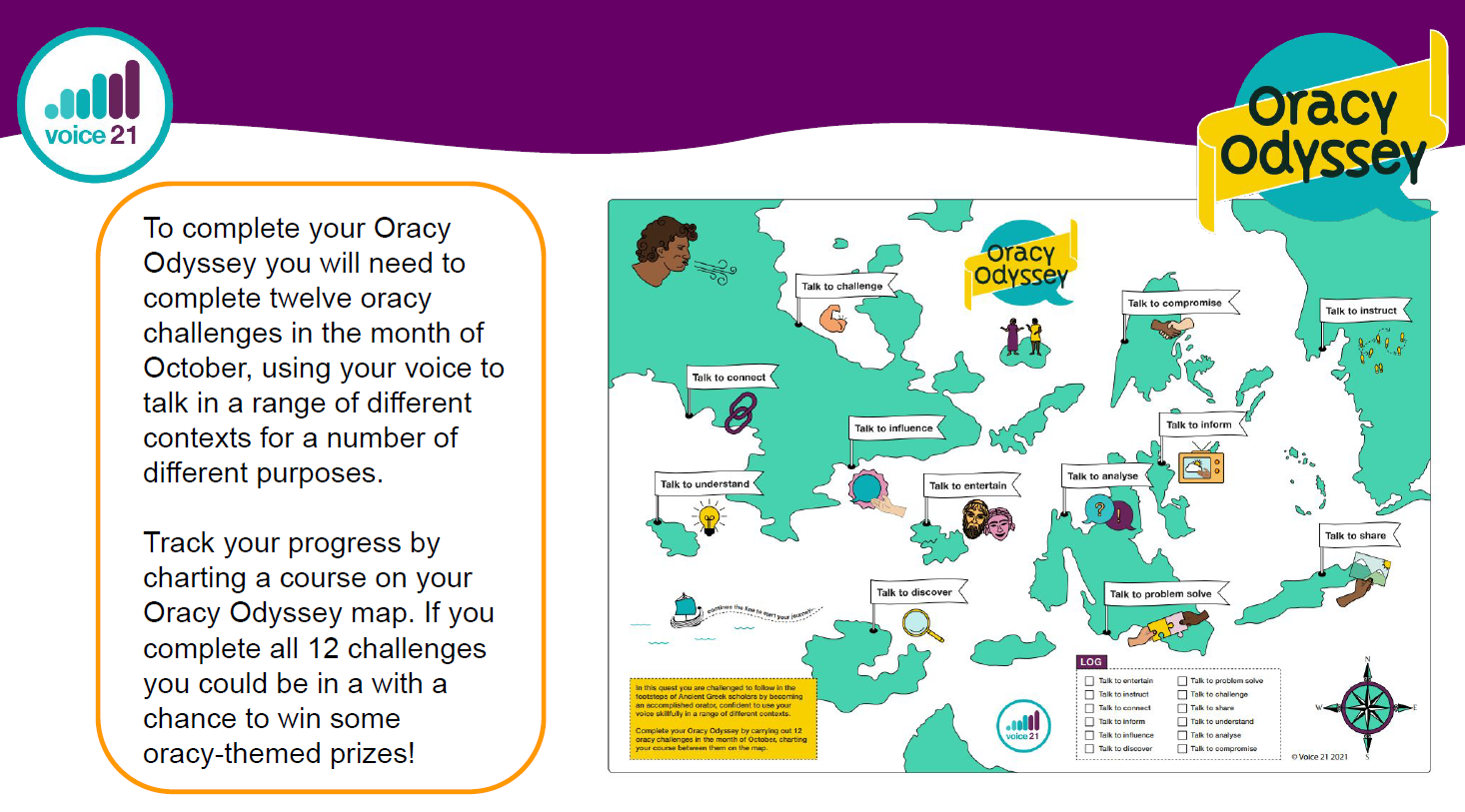
Our October Odyssesy!
Oracy was a highly prized skill in Ancient Greece. Ancient Greek scholars were expected to be able to speak convincingly on a
range of different topics in a number of different settings, such as public forums, courtrooms and assemblies. During the month of October, St Mark's were challenged to follow in the footsteps of these famed Ancient Greek scholars by completing twelve oracy
challenges across the month. Our aim was to empower our children to become accomplished orators just like the scholars of Ancient Greece who worked hard to master the art of the spoken word.